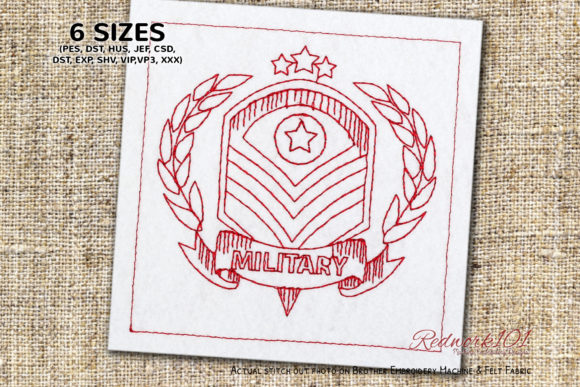
Air Force Sign Embroidery Design: A Designer's Business Review
When a new embroidery file lands on my desk for review, my first question isn't just "does it look good?" but "will it perform as a functional, reliable asset for business merchandise?" The Air Force Sign design, categorized under Military themes, presents itself as a bold, emblematic statement. From a professional design standpoint, its initial impression leans strongly toward a classic, authoritative, and premium feel. The described optional stitch box suggests a foundational structure, which is a positive indicator for consistency across applications—a crucial factor for brand identity.
The Visual Personality for Branded Merchandise
For a small business owner—be it a café with a patriotic theme, a boutique selling handmade goods, or a creative studio offering custom apparel—the Air Force Sign carries a weight of tradition and strength. This isn't a playful or rustic decorative motif; it's a design that communicates confidence and heritage. When used thoughtfully, it can elevate a product's perceived value, fostering customer trust and recognition. Imagine this design on the chest of a staff apron in a bakery, or as a sleeve detail on a uniform for an event security company. It speaks to professionalism and a sense of purpose.
Real-World Performance Across Business Applications
Let's break down how this embroidery design might perform in the hands of embroidery shops and merch creators.
Embroidered Patches & Product Labels
The Air Force Sign has strong potential as a stand-alone embroidered patch. For an Etsy seller crafting military-themed accessories or a pet brand with a "service dog" line, a well-executed patch can become a signature product add-on. However, its success hinges on detail preservation at smaller sizes. Before committing to production for patch blanks, you must test the digital embroidery file at your intended patch dimensions. High stitch density or intricate outlines can become muddled on a small scale, affecting the handmade presentation.
Uniforms, Caps, and Workwear
For cap embroidery or as an accent on polo shirts, the design's bold nature is advantageous. On curved surfaces like cap fronts, simpler, clearer designs fare better. Evaluate the spacing within the Air Force Sign; tight lettering or complex interlocking elements might not translate well on a steep curve without careful digitizing adjustments. On dark uniform fabrics, thread color contrast is paramount. You'll need to review the provided color palette and potentially adjust for maximum visibility.
Tote Bags, Aprons, and Customer Gifts
This is where the design can shine for boutique merchandise and customer gifts. Embroidered onto a tote bag or apron, the Air Force Sign acts as a durable brand mark. Its classic aesthetic aligns well with products meant for frequent use, like work shirts or reusable bags. The concern here shifts to fabric texture and durability. Always test on the actual fabric you'll use for production—a canvas tote versus a linen apron behaves differently. Using the proper stabilizer is non-negotiable to maintain crispness after repeated washes, which is essential for customer satisfaction.
Critical Considerations for Professional Use
An experienced embroidery designer never skips the due diligence phase. Here are practical notes for commercial embroidery projects using this file.
- Test in Monochrome First: Run a test stitch-out in black and white thread on a neutral fabric. This strips away color bias and reveals the true structural integrity of the design's outlines and fills.
- Confirm Hoop Size Compatibility: The product description mentions an optional stitch box. This implies a defined working area. Match this to your machine's hoop capabilities for the intended product. A design destined for a small product label needs a smaller hoop than one for a jacket back.
- Create a Printable Mockup for Client Approval: Before stitching on final products, generate a mockup. Place the Air Force Sign alongside your other design assets to ensure visual consistency across your brand's merchandise.
- Check Commercial Licensing: The description does not specify license terms. It is imperative to confirm that the digital embroidery file is cleared for commercial use before applying it to items for sale.
Where to Apply Extra Caution
While versatile, some applications require a meticulous approach.
Using the Air Force Sign on items with tiny lettering (if present) or very high stitch density demands a perfect setup. On textured fabrics like some sweaters or heavy canvas, detail loss is a risk. For dark uniforms or black caps, a color test on the actual dark material is essential—a light-colored thread scheme on screen might look starkly different stitched on black. Finally, for any item destined for industrial laundering or frequent customer washing, such as staff uniforms, a durability test on a spare piece of fabric is a smart business practice.
Final Impact on Brand Identity and Buyer Engagement
Incorporating the Air Force Sign into your small business merch strategy is not merely a decorative choice. It's a brand identity decision. For a business aligned with values of service, strength, or tradition, this design reinforces that message visually. On custom apparel, it enhances professionalism. On a handmade product, it adds a layer of polished craftsmanship that engages buyers looking for quality. Its success, however, is entirely dependent on technical execution. A poorly stitched, blurry version undermines trust; a crisp, well-placed emblem builds it.
My recommendation is to treat this as a significant design asset. Procure the file, run the rigorous tests outlined above, and only then integrate it into your line of embroidered patches, caps, tote bags, and branded product labels. When done correctly, the Air Force Sign has the potential to become a recognizable and respected symbol on your merchandise, carrying the weight of its theme with the durability demanded by real-world business use.